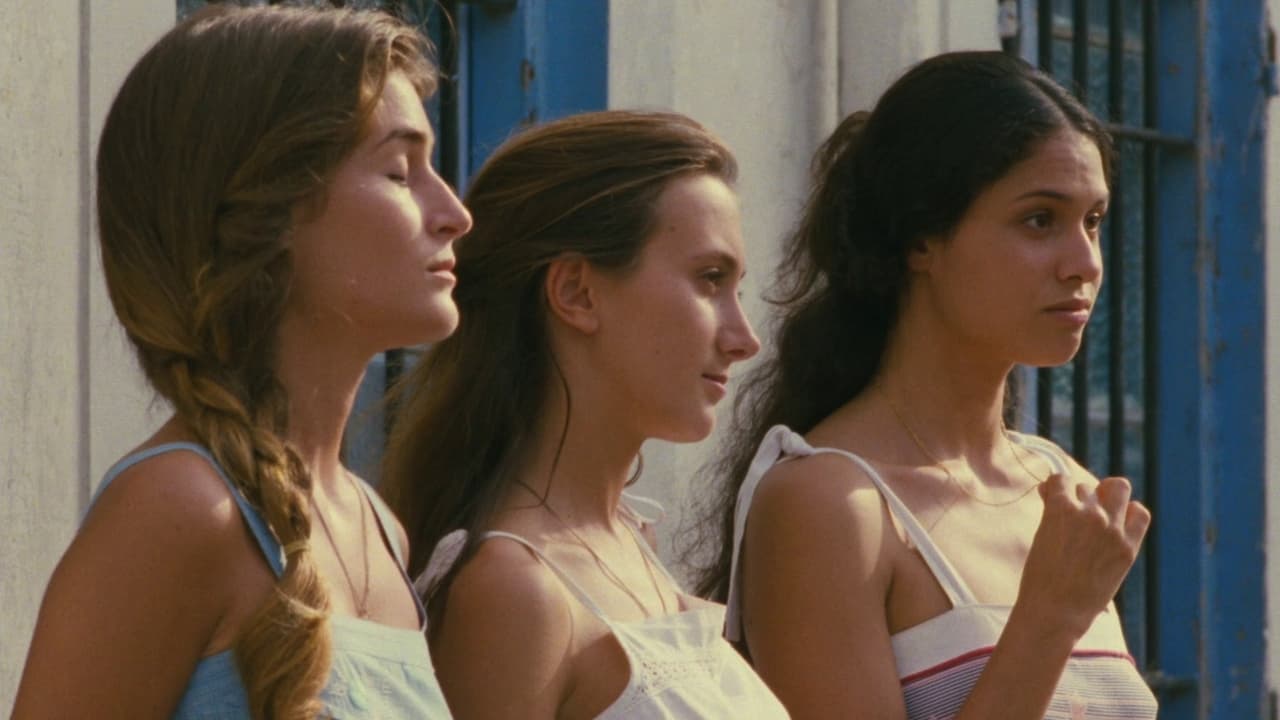
Summer of 1967. La Goulette, a touristic beach of Tunisia, is the site where three seventeen-year-old girls live: Gigi, Sicilian and Catholic; Meriem, Tunisian and Muslim; Tina, French and Jewish. They would like to have their first sexual experience during that summer, challenging their families. Their fathers, Youssef, Jojo and Giuseppe, are old friends and their friendship will be in crisis because of the girls, while Hadj, an old rich Arab, would like to marry Meriem.
1 take · 0 hearts · 0 replies
Glad I didn't grow up in the 90s. In the midst of political instability and a looming war, the movie offers a snippet of life in la Goulette, where we mostly follow the story of three girls who want to lose their virginity and how problematic this desire is for them and their families. Despite coming from different upbringings, each with a different religion, it seems that the sacred link connecting these holy religions is the pride in keeping a daughter’s virginity intact. The movie jumps from character to character. While it occasionally loses itself, it still manages to stay on track. All of these main characters are fully fleshed out and distinct, despite some weak performances from a few actors. However, these shortcomings don’t significantly detract from the overall experience. As a Tunisian, I found the movie difficult to watch. It reeks of colonial footprint, most of the dialogue isn’t even in Arabic. Luckily, that’s just surface level as it ultimately remains a fundamentally Tunisian film. With its wacky characters and relevant themes, the film is undoubtedly a product of its time, a painting lost to the past. Whether through its visuals, the Tunisian architecture, the conviviality of neighbors who don’t even bother closing their doors, or the dialogue that feels almost like an ancient language, the movie encapsulates an era long gone. Most importantly, it portrays a coexistence of the three main religions, side by side, door to door, an image that people my age can only see in movies. On the brighter side, the modernization of Tunisian society has brought a few benefits, particularly in relation to women. The obsession and fuss about virginity and its connection to family honor, while 30 years later still a topic met with frown eyebrows, its at least no longer met with the same drama and humility it once has. I’m not saying its something we left behind entirely, but rather that it is now acknowledged more as a religious concern than a societal one. and its not the prime meaning of having a daughter..